

our story
what was born out of loss became love

My mom passed away in 2019.
With the loss of my dad almost 15 years earlier, her death hit me hard, and despite being an adult, it left me feeling like I'd been orphaned. I was grateful she was no longer suffering, but entirely devastated by the loss. I was surprised — maybe more than I should have been — by how hard the grief hit me, and how lonely I felt in the first days and weeks after losing her.
I didn't want to burden the people around me with my sadness. But feeling joy felt like a betrayal of her memory. So, I turned inward, trying to carry my grief quietly.
What I didn't yet understand was that grief doesn't work that way. It doesn't shrink because we ask it to. It just goes underground.
Grief draws an invisible line between who you once were and who you are now. It shows you what matters. It asks you, if you let it, how you want to live on the other side of it.

My sister and I traveled to India to perform last rites for my mom. We'd performed the same rituals with her for my dad, but for the most part, despite being rooted in so many other aspects of our culture, we'd grown up with these grief rituals at a distance.
Carrying out these rituals offered my sister and me a beautiful reminder that humans have always built ceremony around loss — honored it as a part of life. A way to say this person mattered. This moment matters. We are changed by this.
Being surrounded by family in those early days, knowing we didn't have to hold all that pain alone, gave me something I didn't know I needed — a place to set down grief that overwhelmed me.

The pandemic arrived on the heels of my mother's passing and suddenly the world was inundated in grief — the loss of life, yes, but also the loss of life as we once knew it. We learned, collectively and painfully, that people may be replaceable in the workplace, but they're not replaceable in our lives.
When all is said and done, our relationships are what remain.
Our rituals are what remain.
When I returned from India I found that in addition to navigating the labyrinth of legal and practical details that come with loss, the world had continued turning as if nothing had happened, and I was expected to turn with it.
At work, sitting in meetings felt surreal. Pointless. While some people acknowledged my loss by leaving sympathy cards in my office, many others didn't know what to say — so they said nothing at all. I didn't blame them.
Most of us don't lack the desire to show up for each other. We lack the language. We lack the ritual. We lack the understanding that sometimes, simply returning, again and again, is enough.

Then one day, the envelopes started arriving.
Every one of us will lose someone — a parent, a partner, a friend, a version of ourselves we can no longer return to. And yet in western culture we have almost no rituals for what comes after. No structure for the long, dark season that often follows. No script for how to keep showing up for someone through a seasons of grief and loss, when the rest of the world has moved on, but their grief hasn't.
That experience led me to a question that has guided so much of what I’ve done since: how do we stay rooted in our humanity to honor and care for each other across the most challenging seasons of life?
Month after month, a small group of friends sent cards and notes of love and encouragement. Quiet, consistent proof that someone still remembered. That I hadn't been forgotten. That the loss the world had moved on from was still being witnessed and held by people who loved me. Those cards and notes — and the empathy and sustained presence behind them — became a lifeline, and eventually, a calling.
I was lucky. I grew up in a family where love was never in question — imperfect, like all families, but never absent. And in the last months of my mother's life, we had time for meaningful conversations. Nothing was left unsaid. She knew she was loved. We knew we were loved by her.
Not everyone gets that. And even when we do, grief still arrives and stays longer than the world expects it to. Longer than most people around us know how to hold.
It’s funny because we know death is a given, and yet we rarely acknowledge that grief is, too.

This question has not only guided my work with moral injury, vicarious trauma, and collective grief that I do through Roots in the Clouds, but it eventually led me to launch ambika creative studio — with love in action empathy cards as our first offering.
Not to fix grief or rush anyone through it, but to give the people who aren't sure how to support someone in their season of loss a way to keep showing up — rituals of care and connection for the long, quiet months after the rest of the world has moved on that say, I'm still here. I still remember. You're not alone.
To restore the language of connection we lost in the rush toward efficiency and individualism.
Because we were never meant to navigate life’s most profound seasons alone.

My hope is that love in action empathy cards will help us shift care and connection from an afterthought to an intentional practice we choose to return to again and again, from one season to the next.
Grief has never left me. But it has changed shape.
It no longer sits in the center of everything. It's grown around me — woven into the fabric of who I am, part of the texture of my life rather than the whole of it. I’ve returned to joy. To laughter. To deep, sustaining connection. To the particular pleasure of being fully present in a good moment without guilt.
For anyone navigating their own season of grief and loss right now — wherever it comes from, whatever it looks like — I share this not as a promise that it gets easier, but as evidence that it gets different. That we can carry it and still be carried. That the invisible line grief draws between who we were and who we are now isn't only rooted in loss. It also carries the seeds of something new — hope.
We don't have to rush toward it. But it’s there.
And for anyone who is struggling to support someone through a season of grief and loss, may this be a reminder that there is no script for this. No right words. All we can do is keep showing up,.
what’s in a name
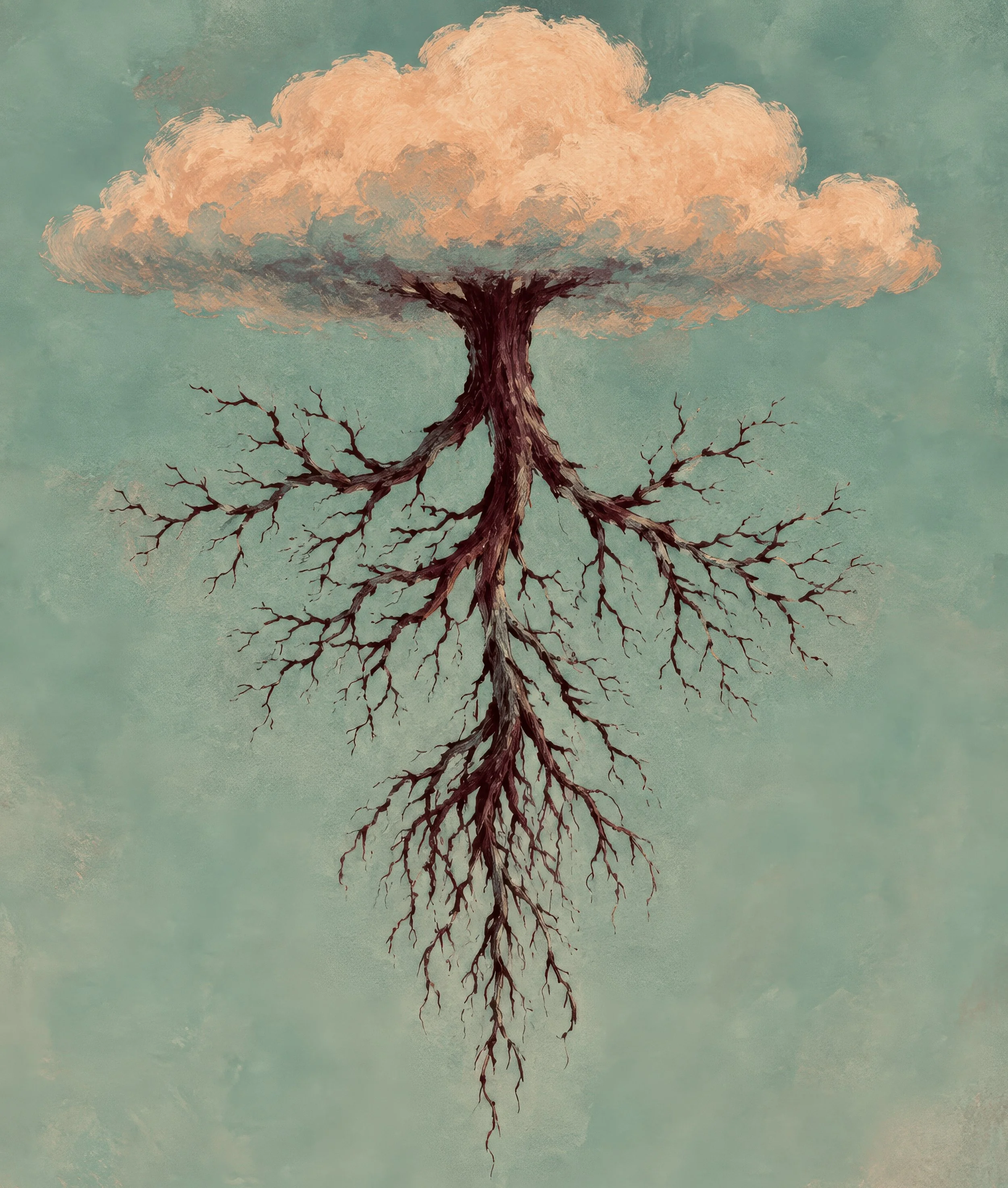
Roots in the Clouds was inspired by the fifteenth teaching of the Bhagavad Gita, which describes an upside-down tree — its roots reaching toward the heavens, its branches tangled in the world below — a representation of the duality of being human. The constant pull between staying grounded in our values, intuition, and conscience, and being pulled into a material world of productivity, profit, and urgency. Through Roots in the Clouds, we help people and organizations map that terrain — naming what's been wounded, the values under pressure, and the pathways back to conscience, care, and sustainable service.
Whether through coaching, writing, or our empathy cards, all of our work comes back to the same thing — staying rooted in our humanity and conscience, and present to one another through life's most challenging seasons.
about the studio
I often think of Roots in the Clouds as the two wings of a bird.
While Roots in the Clouds maps our internal and external terrain through different seasons of life — loss, transformation, renewal, celebration, our creative studio creates offerings for moving through them with empathy, connection and care.
Here, we move against the grain of fast, disposable media, reimagining publishing not as product, but as practice. In a time of deepening grief and dehumanization, choosing to slow down, stay human, and keep caring for one another is its own form of sacred resistance. Spaces where story becomes sanctuary. Connection becomes ritual. Art becomes a pathway to presence and collective care.
Our process blends artistry with ritual, design with contemplation. Every offering is made in small batches and released with the rhythm of seasons, not markets. And because ritual is a birthright, not a luxury, our vision is to create offerings that are both beautiful and accessible, so the practice of connection can live in everyone's hands.
This ethic of care shapes everything we do, including how we think about abundance. A percentage of every sale from the studio supports organizations working for the good of our communities and our planet — because true connection means tending not just individual relationships, but the broader systems that sustain all life.
Creating intentionally. Releasing seasonally. Resisting spiritually.
about dimple

Dimple Dhabalia is an attorney, award-winning author, writer, and speaker. The daughter of Indian immigrants — her mother born and raised in Uganda, her father in India — she grew up with family stories and rituals carried across continents, an inheritance that later drew her to nearly two decades of work in asylum and refugee operations for the U.S. government before founding Roots in the Clouds.
Her work at the intersection of moral injury, collective grief, and human connection has been guided by a single question: how do we honor and stay rooted in our humanity as we navigate different seasons of life?
Through Roots in the Clouds and ambika creative studio, she is restoring the language of connection and rituals of care — creating pathways to presence that invite us to stay rooted in our empathy and conscience, not as afterthoughts, but as intentional practices we choose to return to in every season.